The Blackburns by Carolyn Rasmussen
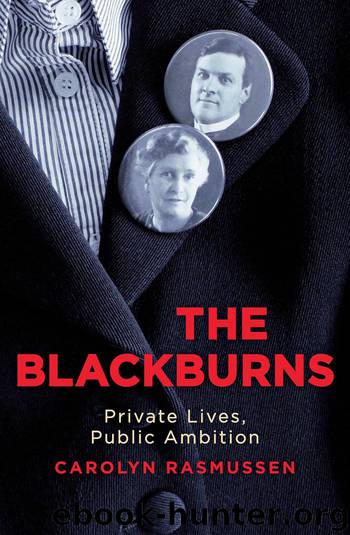
Author:Carolyn Rasmussen
Language: eng
Format: epub
ISBN: 9780522874464
Publisher: Melbourne University Publishing
11
WIDENING HORIZONS, 1932–37
‘He has a way with him’
On 12 April 1932, with Tom Tunnecliffe as acting premier, the leader of the United Australia Party (UAP), Stanley Argyle, launched a successful no-confidence motion. Given only a month’s notice for the election on 14 May, the Victorian central executive (VCE) automatically endorsed sitting members. On the motion of Blackburn, it also agreed not to contest Ned Hogan’s seat of Warrenheip or Ernie Bond’s seat of Port Fairy-Glenelg, despite their continued support for the Premiers’ Plan financial arrangements in defiance of party directives. It was a generous gesture not replicated in the Clifton Hill branch of Blackburn’s electorate, which harboured the group around ‘Sugar’ Roberts that was still itching for redress against their defeat in Fitzroy in 1925. The secretary of the branch, William Angus, stood as an independent supporting Hogan, but Blackburn scraped back in. Labor was reduced to sixteen seats in the election, its lowest number since 1907. Still, W. J. Duggan, secretary of the THC, spoke for many when he observed that he was ‘not sorry’ to see the Hogan Government defeated.1 And so it was that the Labor Party’s ‘first substantial era of government had closed with the movement still seemingly nonplussed about how to manage itself in office and in an existential funk about whether it was not preferable to bide its time in the sanctuary of opposition after all’.2
On 21 May, Blackburn, now back on the central executive,3 moved a motion that Hogan, Esmond Kiernan, J. P. Jones, Bond, Henry Bailey and Henry Williams ‘should show cause why they should not be excluded [from the party] for breaching the January 1932 resolution on the Premiers’ Plan’.4 On 1 July Hogan, Kiernan, Jones and Bond were duly excluded. Hogan protested bitterly that he would not be subject to ‘Rafferty’s or Blackburn’s rules’,5 and took the matter to court. In his mind he was a martyr and Blackburn was the architect of his demise, but that is to credit Blackburn with aspirations or even influence he did not have. There can be little doubt, though, that he acted as solicitor for the VCE with some relish during the extended legal battle, which Hogan first won and then lost. In 1934 the High Court found against Hogan in a decision that established the legal autonomy of all political parties. It was, in Blackburn’s view, ‘a Charter of Freedom’,6 and perhaps some recompense for the particularly egregious public attack on him Hogan had mounted back in July 1931.7
Following Hogan’s expulsion, Blackburn was once again being carried aloft on the shoulders of supporters ‘from outside parliament’ to contest the leadership of the party, in mid-July 1932.8 The myth-making about the brief terms in government by the Victorian Labor Party involving ‘ritual incantations about having been led astray by a few mountebanks’ enveloped Blackburn too.9 Unlike the Fitzroy by-election, when he did indeed wish to return to parliament, it is likely that Blackburn accepted this endorsement rather lukewarmly. It must have been clear from the outset that Tunnecliffe would have the numbers.
Download
This site does not store any files on its server. We only index and link to content provided by other sites. Please contact the content providers to delete copyright contents if any and email us, we'll remove relevant links or contents immediately.
Waking Up in Heaven: A True Story of Brokenness, Heaven, and Life Again by McVea Crystal & Tresniowski Alex(37811)
Empire of the Sikhs by Patwant Singh(23086)
We're Going to Need More Wine by Gabrielle Union(19046)
Hans Sturm: A Soldier's Odyssey on the Eastern Front by Gordon Williamson(18592)
Leonardo da Vinci by Walter Isaacson(13336)
The Radium Girls by Kate Moore(12028)
Tools of Titans by Timothy Ferriss(8396)
Educated by Tara Westover(8054)
How to Be a Bawse: A Guide to Conquering Life by Lilly Singh(7486)
Permanent Record by Edward Snowden(5847)
The Last Black Unicorn by Tiffany Haddish(5636)
The Rise and Fall of Senator Joe McCarthy by James Cross Giblin(5280)
Promise Me, Dad by Joe Biden(5153)
The Wind in My Hair by Masih Alinejad(5095)
A Higher Loyalty: Truth, Lies, and Leadership by James Comey(4964)
The Crown by Robert Lacey(4817)
The Iron Duke by The Iron Duke(4356)
Joan of Arc by Mary Gordon(4112)
Stalin by Stephen Kotkin(3966)
